
Introduction
With the rise of automation and increasing demands for highly accurate parts, the CNC lathe machine market is growing at a fast pace. The same types of CNC lathe machines from different brands may hold a massive price difference; have you ever wondered why that is so?
Simply said, it is not only about the price tag that equipment holds. It’s dependent on the features’ size, specifications, brand, after-sales, and long-term value that add to the machines.
Precisely, a CNC lathe will cost you anywhere from $ 1,000 to $500,000, ranging from hobbyist models to high-end lathes.
In this article, let’s break down the CNC lathe machine cost according to different aspects. It will help you plan smartly for your next purchase. So, let’s begin.
CNC Lathe Price Ranges
Skill level and project requirements are the core factors in determining the size of the CNC lathe that will suit your needs perfectly. For example, a hobbyist or beginner lathe does not require high automation, unlike an industrial lathe used for large-scale production.
So, with these types of differences, the price scale often fluctuates. Let’s discuss the price range of CNC lathes according to their size and level.
Hobbyist/Small
These machines are compact and beginner-friendly and can cost ranging from $1000-$5000. They are suitable for hobbyists, home workshops, and educational centers. They mostly come with manual controls. Used for home workshops and DIY enthusiasts. Benchtop models are best suited for hobbyists and smaller setups.
| What do they offer? |
|
|
|
Entry-Level
Starting from $5,000 to $20,000, entry-level CNC lathe machines provide basic functionality. They are used for light production and manufacturing small, basic parts. They may be manual or sometimes come with semi-automatic control for simple operation. You can use them in small workshops with beginner-level operator skills. They can also be used in training centers for students.
| What do they offer? |
|
|
|
|
Mid-Range
Mid-range CNC lathe machines feature some level of advancement. They mostly range from $20,000 to $80,000. They are more accurate and best for entry to mid-level manufacturing businesses. They are designed for the daily production of parts and can fulfill mid- to large-scale production orders. With a better accuracy level compared to entry-level machines, they can produce somewhat complex parts. If you are someone who wants to start a manufacturing business, these machines will be perfect for you, as they are relatively simple to operate. However, at the same time, they will provide parts with greater accuracy, accommodating a wider range of materials.
| What do they offer? |
|
|
|
|
High-End
Versatile, highly automated, and fast, these high-end CNC lathe models are best for large-scale industries and factories. Their price range is $80,000- $500,000+. Although they come with a higher price tag, they deliver incredible results and are worth it. If someone is looking for an upgrade to increase production efficiency, these machines will be the ideal fit.
| What do they offer? |
| Fully automated machines with features with live tooling and robotics, multi-axis machining |
| Complex software integration |
| High-speed spindle for large-scale production |
Key Factors Affecting CNC Lathe Machine Cost
Types of CNC Lathes
- Horizontal vs. Vertical CNC Lathes
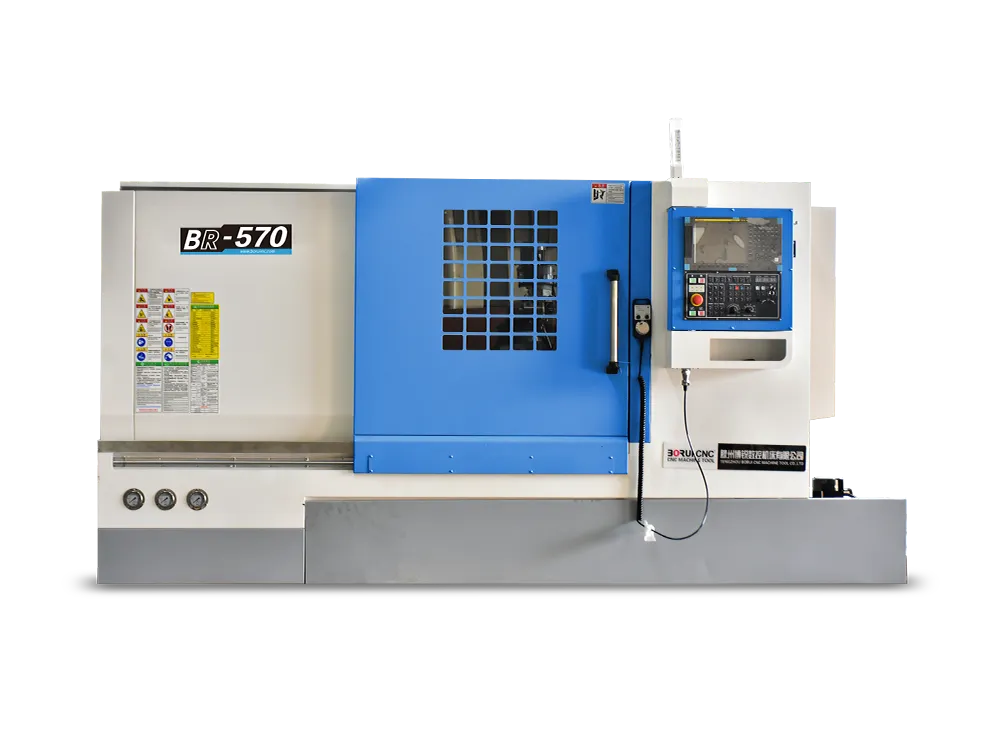
Horizontal lathes are the everyday choice for shafts, sleeves, and bar work. They are commonly used in the industry. Vertical lathes hold large, heavy discs and rings, handling heavy parts with ease. So, they usually price above similar horizontal models.
- 2-Axis vs. Multi-Axis CNC Lathes
2‑axis machines (X/Z) handle core work. This includes turning, facing, and threading with lower cost and simpler programming. Multi-axis systems add a Y-axis, live tooling, a sub-spindle, and sometimes a B-axis, enabling milling and off-center features in a single setup. Adding each additional axis or spindle increases the price and setup time. However, it cuts changeovers and can finish parts in a single run.
- Swiss-Type vs. Standard CNC Lathes
Swiss-type machines use a guide bushing to support long, slender parts near the cutting area. They are ideal for tiny, high-precision components. Standard lathes typically utilize a chuck or collet without a guide bushing, allowing for a wider size range in general turning applications. So, ultimately, Swiss-type costs more.
Features and Configurations
- Axis count: 2‑axis is the cheapest. Adding a Y‑axis, live tooling, or a sub‑spindle raises the price. But it enables one‑and‑done parts.
- Controls: Premium control systems (FANUC/Siemens/Mitsubishi) account for a significant portion of the cost. They offer stability, fast cycles, and easy integration.
- Motor Power: A strong motor will provide high efficiency and deeper cuts.
- Bed length and swing over bed: larger bed lengths and swing let a lathe handle wider diameters and longer parts. However, they require additional floor space and a higher budget.
- Tool turret and number of tools: Each added tool results in faster cycles and fewer changeovers. Yet they add cost and setup time, especially with powered tooling.
Brands and Manufacturers
The brand and manufacturer will significantly impact pricing, quality, and after-sales service.
Premium brands such as Mazak, DMG MORI, Okuma, and Haas offer high-quality products. However, they generally command higher prices due to their superior build quality, reliability, extensive service networks, and higher resale value.
There are cost-effective options, too. China is a manufacturing hub, and Chinese manufacturers like Borui can reduce upfront costs. We offer reliable quality and fast after-sales support.
Additional Costs
Some hidden and additional costs are often missed, but they serve an important role in the total cost. Here are some of them that affect equipment cost:
- Installation and site preparation: rigging, freight, power work, and foundations can add 10–20% or more to the landed cost. It depends on the terms and facility changes.
- Tooling, workholding, metrology: cutters, inserts, chucks, collets, and probes can cost several thousand upfront. Additionally, they are considered ongoing consumables.
- Software and programming: CAM, posts, and DNC add licenses and training time, which increases the overall cost. Often missed in budgets, but part of the total ownership cost.
- Equipment maintenance: These machines require regular maintenance. The cost adds up for specialized or hard-to-find parts, as well as preventive maintenance. Professional repairs may also be costly due to breakages.
- Operator training: High-end machines require highly skilled and technically trained operators. You can hire trained professionals or conduct in-house training for your employees. Whatever you opt for, both are expensive.
How to Choose the Right CNC Lathe
- Define parts and volumes. List max diameter, length, tolerances, and materials. Estimate monthly batches and peak demand. This sets size, power, and accuracy targets.
- Set a budget band. Align needs to be a tier: hobby/small for minimal spend, entry-level for basic production, mid-range for versatility, and high-end for complex or 24/7 use. Leave margin for tooling and installation.
- Match capacity. Select the chuck size, bar capacity, and Z-travel to accommodate the largest planned job. Pick a slant‑bed for better chip flow and rigidity. Size the spindle bore for bar work.
- Choose axes and tooling. 2‑axis is the lowest cost. Add a Y-axis, live tooling, or a sub-spindle if one-and-done parts require cut setups and labor. Confirm turret stations and toolholder style.
- Power and coolant. Specify spindle power/torque for the hardest alloy. Add high‑pressure coolant for tough materials and deep holes. Plan chip control early.
- Accuracy and stability. Verify repeatability, thermal compensation, and consider options for ballscrews or scales. Add probing if tolerances are tight. Ask for a sample cut.
- Controls and CAM. Select a control family that matches current CAM posts and team skills. Favor stable, well‑supported platforms to reduce training time.
- Automation path. Start with the parts catcher and bar feeder if throughput is a priority. Add robots later when volumes justify payback. Ensure safety and monitoring.
- Total cost of ownership. Budget rigging, freight, power upgrades, tooling, metrology, software, training, service, and spares. Include planned maintenance and downtime risk.
- Support and warranty. Verify local technician availability, parts supply, and response times. Review warranty terms and commissioning support. Get user references and cycle‑time data.
- Validate ROI. Request a time study on a real part. Compare cycle time, finish, scrap rate, and changeovers against the budget band. Buy the least complex machine that meets the target.
Where to Buy for the Best Deal?
If you are in the market for the right purchase and prefer the best deal, consider a direct purchase. Start by shortlisting specs and target price. Research for a manufacturer and review its history and reviews. Request a factory quote that includes delivery, installation, and tooling. Ask for bundle deals. Some manufacturers offer technical support, training, and maintenance as part of their packages. While other manufacturers charge individually for these offerings. Also, check the availability of spare parts.
Buying direct reduces markups and speeds support. It also ensures correct options and control packages. Once you have thoroughly reviewed everything, compare, negotiate, and place the order with the manufacturer for full factory backing. For a streamlined purchase and responsive after‑sales service, buy directly from a certified manufacturer like Borui.
Conclusion
Now that we have discussed the CNC lathe machine cost across all four tiers, you can decide which one best suits your requirements. Don’t overspend; instead, look for the right choice, considering production volume, long-term costs, and a trustworthy manufacturer. There are numerous options to suit every need. Research and compare your options for the best deals.
Remember, costly machines do not necessarily mean reliable machinery; other factors also contribute to the overall cost. So, choose mindfully.
A right CNC lathe machine awaits – contact us for more information!